


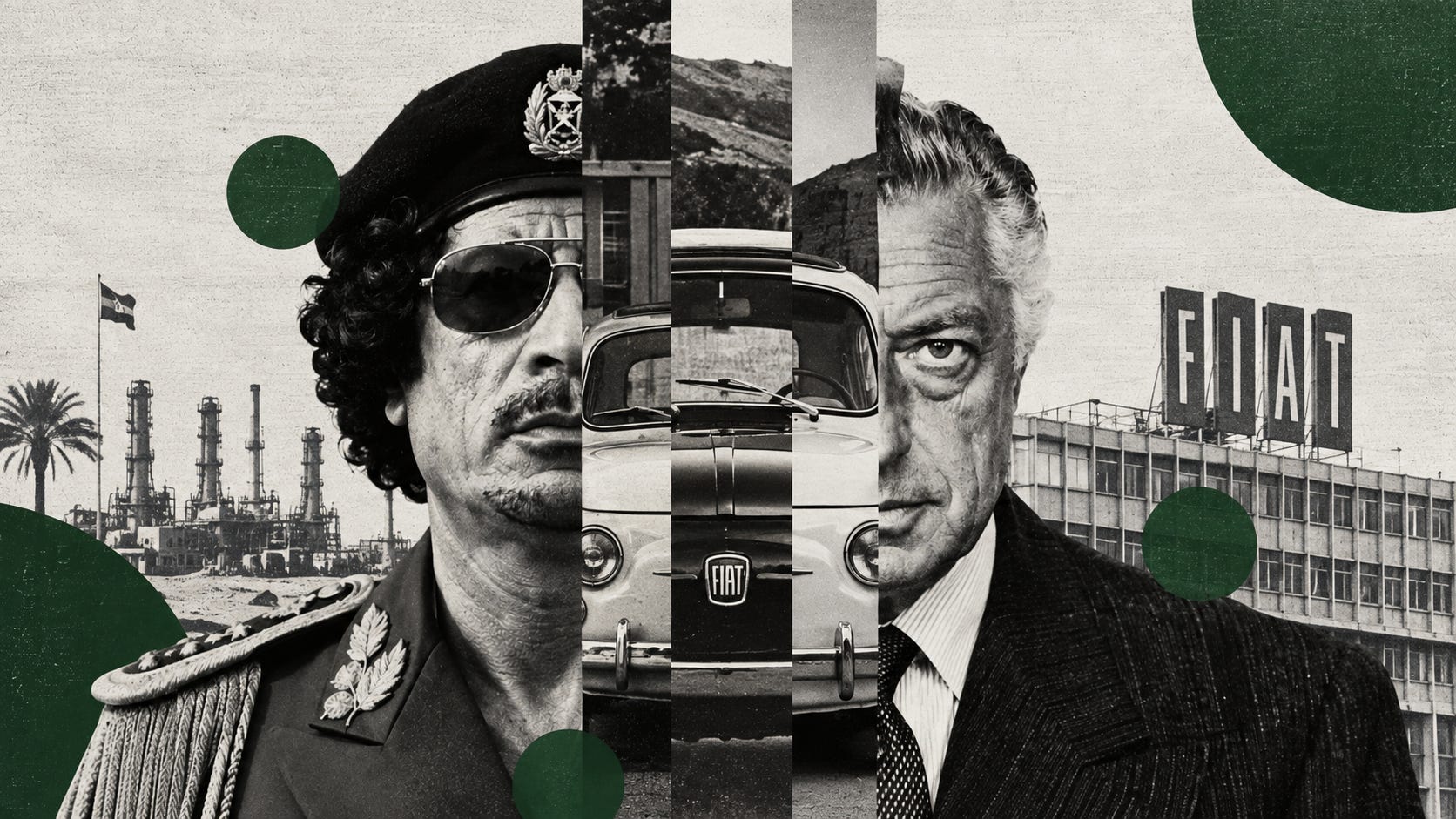
I discovered this week that Muammar Gaddafi’s Libya once owned around 15 per cent of Fiat.
This is exactly the kind of information that makes it difficult for me to accomplish whatever I was supposed to be doing before I learnt it.
In December 1973, La Stampa, the Turin newspaper owned by Fiat, published a satire about Gaddafi. He was not amused and threatened to put Fiat on an Arab boycott list unless the paper’s editor, Arrigo Levi, was fired. Fiat chairman Gianni Agnelli refused.
Three years later, they became business partners.
Fiat needed money. The oil shock had been unkind to the car industry and Libya, having oil, had rather a lot of it. In December 1976, Libya put roughly $415 million into Fiat through shares, bonds and a loan, initially taking about a tenth of the company and two seats on its board. Its position eventually grew to around 15 per cent.
So one of the great symbols of Italian capitalism spent roughly a decade with Gaddafi’s Libya as its second-largest shareholder.
There is something wonderfully 1970s about the whole arrangement. An oil-rich revolutionary government and an aristocratic Italian industrial dynasty, separated by ideology but united by that most enduring basis for international cooperation: one had money and the other needed it.
And for a while, it worked.
By 1986, however, having Libya on the shareholder register had become considerably less convenient. Fiat was pursuing American defence business, the Reagan administration had blocked a Pentagon contract involving the company because of the Libyan stake, and Agnelli wanted the shares back. Libya eventually sold its holding for about $3 billion.
Not a terrible outcome for a relationship that began with an insult in a newspaper.
I like corporate histories like this because they ruin the neatness we impose on companies after the fact. Once a business survives, its history becomes a sequence of apparently sensible decisions leading inevitably towards the company we recognise today. Emergency financing becomes strategic capital, improbable partnerships become international expansion and decisions made under considerable uncertainty eventually acquire arrows and boxes in business school case studies. I had the bright idea of attending business school, so thankfully my scholarship paid for me to look at some of these arrows.
Living through it is considerably less tidy, as I have been thinking about that this week because something we had spent time preparing fell apart almost immediately. There had been research, schedules, travel and a number of documents suggesting a plan existed. Roughly 24 hours later, I was back home.
There is probably a version of this paragraph in which I extract seven lessons about resilience, but I’m no LinkedIn creator. Mostly it reminded me that the sunk-cost fallacy is considerably easier to understand when the sunk costs belong to somebody else.
Then Monday arrives anyway, which is perhaps the least glamorous but most accurate thing I have learnt about running a company. Whatever happened last week, there is still a company to build this week.
Somewhere in the middle of doing that, I also put myself inside my own brain and staged an Al Baik heist, albeit entirely with AI.
I’ve been experimenting rather obsessively with generative AI lately, partly because it makes ideas possible that would previously have required a crew, locations, VFX and a budget large enough to discourage me from having them in the first place.
What interests me is what happens when imagination becomes cheaper to execute. I can now spend an evening directing a computer through my own eyeball or stealing fried chicken from the back of a vintage Land Cruiser. This will undoubtedly produce an extraordinary quantity of rubbish, but it also gives strange ideas considerably more room to become good ones.
Perhaps this is why I keep coming back to the Fiat story.
We have a tendency to look backwards and mistake outcomes for plans, as though the strange turns were always part of the strategy because eventually somebody found a coherent way to explain them.
Fiat presumably did not begin the decade planning to put Gaddafi on its cap table. Very little of 2026 has unfolded the way I expected it to either.
The plans change, the sensible thing occasionally fails and the ridiculous thing occasionally works. Then enough time passes and somebody draws an arrow between the two.
I find that oddly comforting this week.
See you next week,
Chaymae