

Every time I post a video or share pictures from a city in what we politely call the rest of the world, the feedback arrives on cue: it looks so modern. While I’m no mind reader, I’m assuming that means, the skyscrapers, or the fact that the people in the frame dress and behave the way they do, or the global consensus on the eight-dollar matcha.
It also carries an assumption I’ve heard my whole life, from both sides of the line between the West and everyone else: that getting rich means becoming Western. That assumption has a history, and the history is far less flattering to the West than the comment suggests.
What interests me about the word modern is how selectively we use it. Nobody visits London, sees a glass tower and expresses surprise that Britain has discovered architecture. But show someone a financial district in Central Asia, a metro station in the Gulf or an aesthetic café in an African capital, and suddenly we’re witnessing a remarkable civilisational achievement.
The compliment is often sincere. That’s what makes it interesting. It reveals an expectation that these places should look fundamentally different from the world the observer recognises.
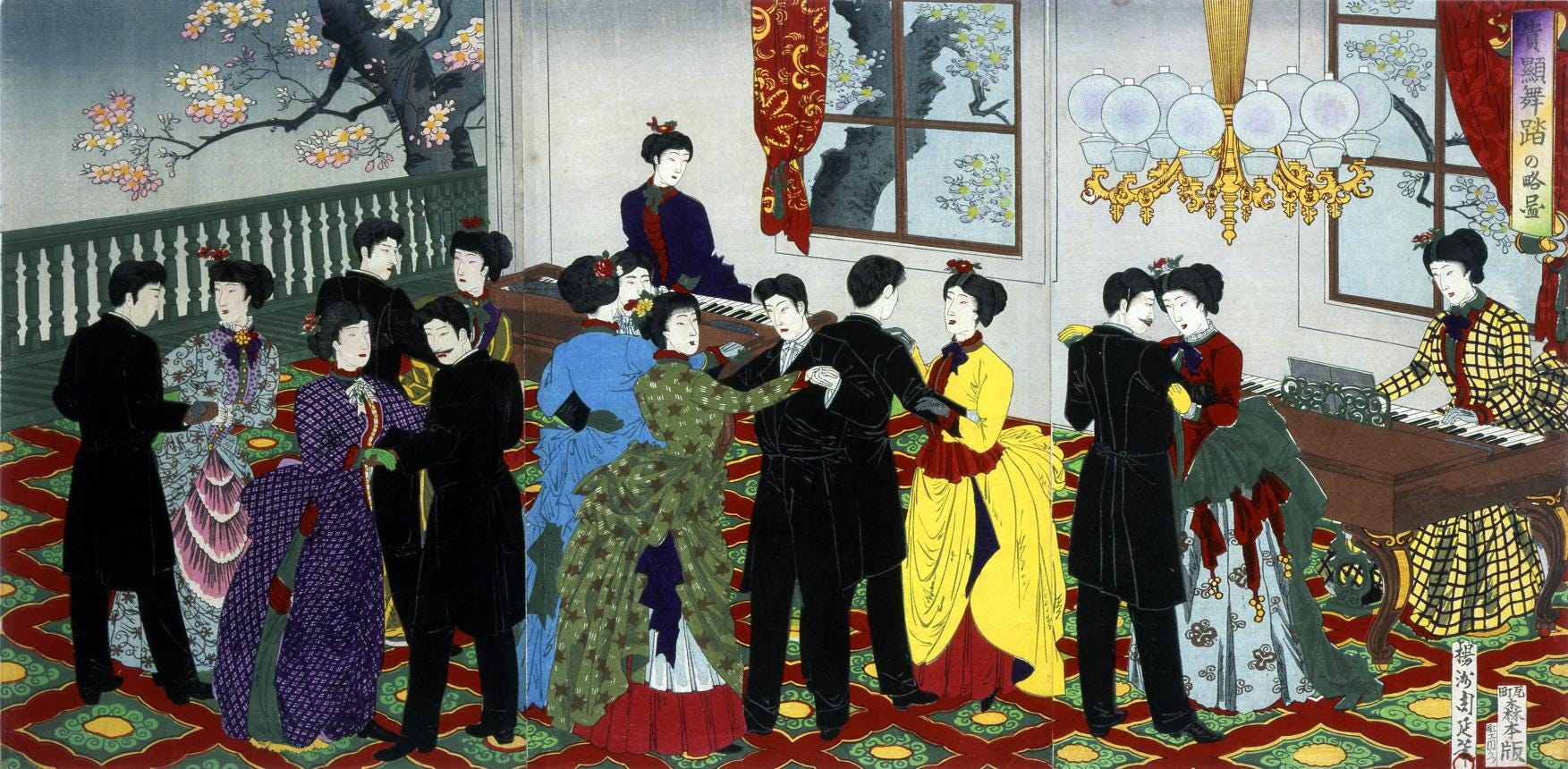
On 28 November 1883, twelve hundred guests arrived at a new brick hall in Tokyo for a party designed to change how the West saw Japan. The Rokumeikan had been designed by a British architect, the menus were printed in French, and the gentlemen wore evening dress cut by tailors in London. Their partners wore the latest Parisian fashions. A military band played European music while Japanese officials worked through the waltz, the polka and the quadrille, steps they had learned from foreign residents hired specifically to teach them.
None of it was for fun. Western powers had forced Japan into unequal treaties under which their citizens could only be tried by their own consular courts, and the foreign minister, Inoue Kaoru, had concluded that the treaties would be revised once the West could see that Japan had become civilised by its own definition. The Rokumeikan was his argument, built in brick and performed nightly.
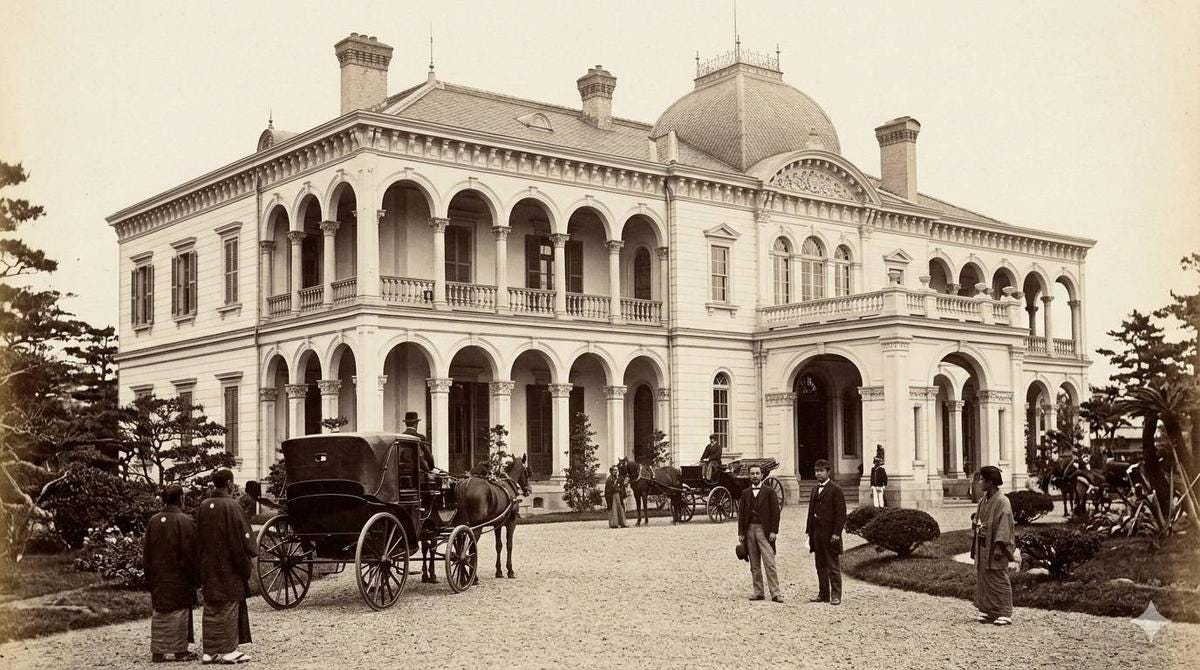
The West watched the performance and laughed. Foreign diplomats enjoyed the balls and described them as ludicrous in their letters and diaries. The French novelist Pierre Loti attended the emperor’s birthday ball in 1886 and, on arrival, wondered whether he had landed in London, Melbourne or New York. Then he compared his hosts to monkeys, again and again. Japan had copied the West almost perfectly, and the reward for perfect copying was contempt. Inoue resigned in September 1887 with the treaties untouched.
More than a century later, very little of the underlying logic has changed.
In 1978, Edward Said published Orientalism, examining how Western writers and scholars had constructed the East as Europe’s exotic, backward counterpart. His argument was not that these descriptions were inaccurate, but that the power to describe another society was itself a form of power.
This is what makes the surprise at a modern-looking city so revealing. Surprise requires an expectation. If a functioning metro system in Central Asia strikes you as unexpected, it’s worth asking what image of Central Asia you were carrying around in the first place.
Historian Dipesh Chakrabarty made a related argument in Provincializing Europe. European historical experience had become the implicit reference point against which other societies were understood. Europe was not just one region among many. Its history had become the standard by which everyone else’s position in history was measured.
And the hierarchy survives in the language. Western countries are modern. Other countries are becoming modern. The distinction quietly assumes that one civilisation represents the present while everyone else is travelling towards it.
And if the West is the destination, then resemblance becomes the measure of how far a country has progressed.
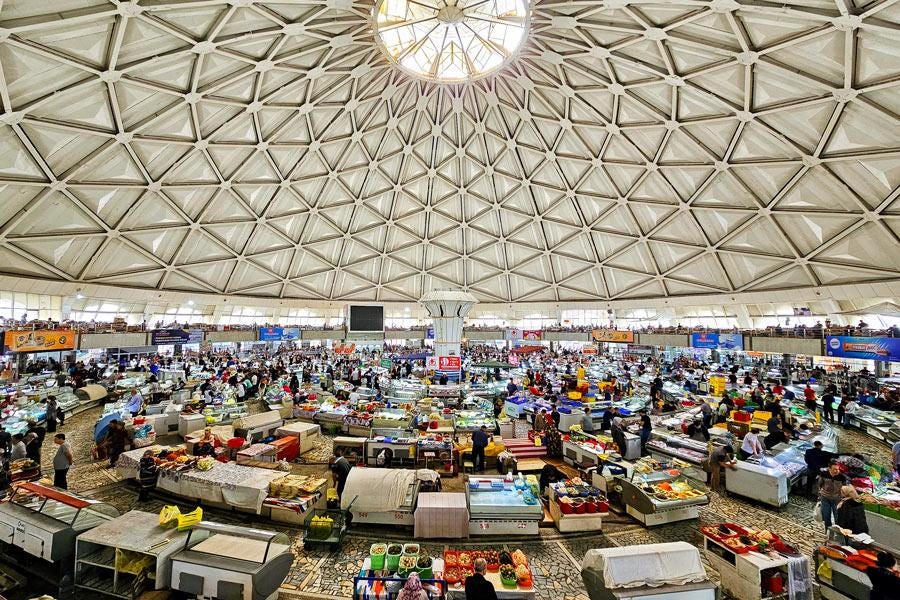
A European-style boulevard appears sophisticated. A traditional market appears authentic. One belongs to the future, the other becomes something tourists visit to experience the past.
Never mind that the market might support thousands of livelihoods, while the boulevard might be an expensive exercise in urban branding.
And this is where the commentary becomes uncomfortable for the West.
Western observers frequently criticise countries for abandoning their architectural heritage, traditional clothing or local character in pursuit of modernity. But those same observers are often the first to describe a city as surprisingly developed when it looks familiar.
There is something convenient about this arrangement. A country that retains its traditional character risks being described as backward. A country that adopts Western aesthetics risks being dismissed as artificial, soulless or inauthentic. Apparently, the ideal non-Western city is one with excellent infrastructure, reliable Wi-Fi and just enough local colour to reassure Western visitors that they’ve travelled somewhere exotic.
So which is it? Should these countries preserve their difference for Western consumption, or erase it to earn Western recognition?
The contradiction suggests that the issue isn’t really modernisation. It’s who gets to define it.